


A silk panel cut on the bias does not behave like one cut on the grain. It yields, breathes, and settles differently over the body. In that small difference lies the whole premise of Dili: a garment is not finished when it leaves the worktable, but when it has been tempered—by time, by touch, by the person who wears it.
What does “tempering” mean in Dili’s work?
The Chinese term 砥砺 (dǐ lì) refers to the grinding and sharpening of stone against stone. It is a process of refinement through pressure and repetition, not a single dramatic act. At Dili, we read this as a making philosophy: grace is not given; it is earned slowly, through repeated contact with the material.
This is why we resist the idea of a “perfect” first draft. A pattern, like stone, reveals its true character only after many passes. Tempering means returning to the same seam, the same drape, the same proportion until the garment stops resisting and begins to hold its own quiet logic.
How does tempering show up in construction?
In practice, tempering is not mystical. It is a set of deliberate construction habits:
- Repeated sampling. We make multiple toiles for a single silhouette, shifting seam lines by millimeters, testing how a pleat falls after hours of hanging, observing where the fabric relaxes and where it needs restraint.
- Slow pattern refinement. A neckline may be redrawn several times before it carries the right tension between openness and support. The goal is not novelty but rightness: a line that looks inevitable.
- Accepting material imperfection. Natural fibers—silk, cotton, linen—carry slubs, subtle shifts in weave, and the memory of their growth. We do not treat these as flaws to be erased. They are part of the garment’s life, the first notes of a patina that will deepen with wear.
Why is softness paired with structure?
Our design language often sets fluid drapery against precise architectural construction. This is not a stylistic tic; it is a philosophical position. Feminine resilience, as we understand it, is neither hard nor yielding—it is both, held in balance. We think of it as half blade, half silk: the capacity to be firm and tender at once.
A soft drape allows the body to move without apology. A sharp seam gives the body definition without constriction. Together, they create a silhouette that adapts but does not collapse. The structure is not armor; it is a frame that lets the wearer occupy space with composure.
Where do we see tempering in the collections?
Each collection translates the tempering ethos through a different archetype and material story:
Nine Orchids
The orchid in literati painting stands for virtue that needs no audience. We translated this into mulberry silk and silk-cotton blends, cut into draped pleats that move with quiet confidence. Structured shoulders and architectural necklines keep the line from drifting into mere softness.
Rose Petals
The rose is often reduced to decoration. Our Rose Petals collection reclaims it through tension: layered silk organza, deconstructed ruffles, and bias-cut silks suggest vulnerability, while structured corsetry and defined waists assert determined bloom. The floral is tempered into something resilient.
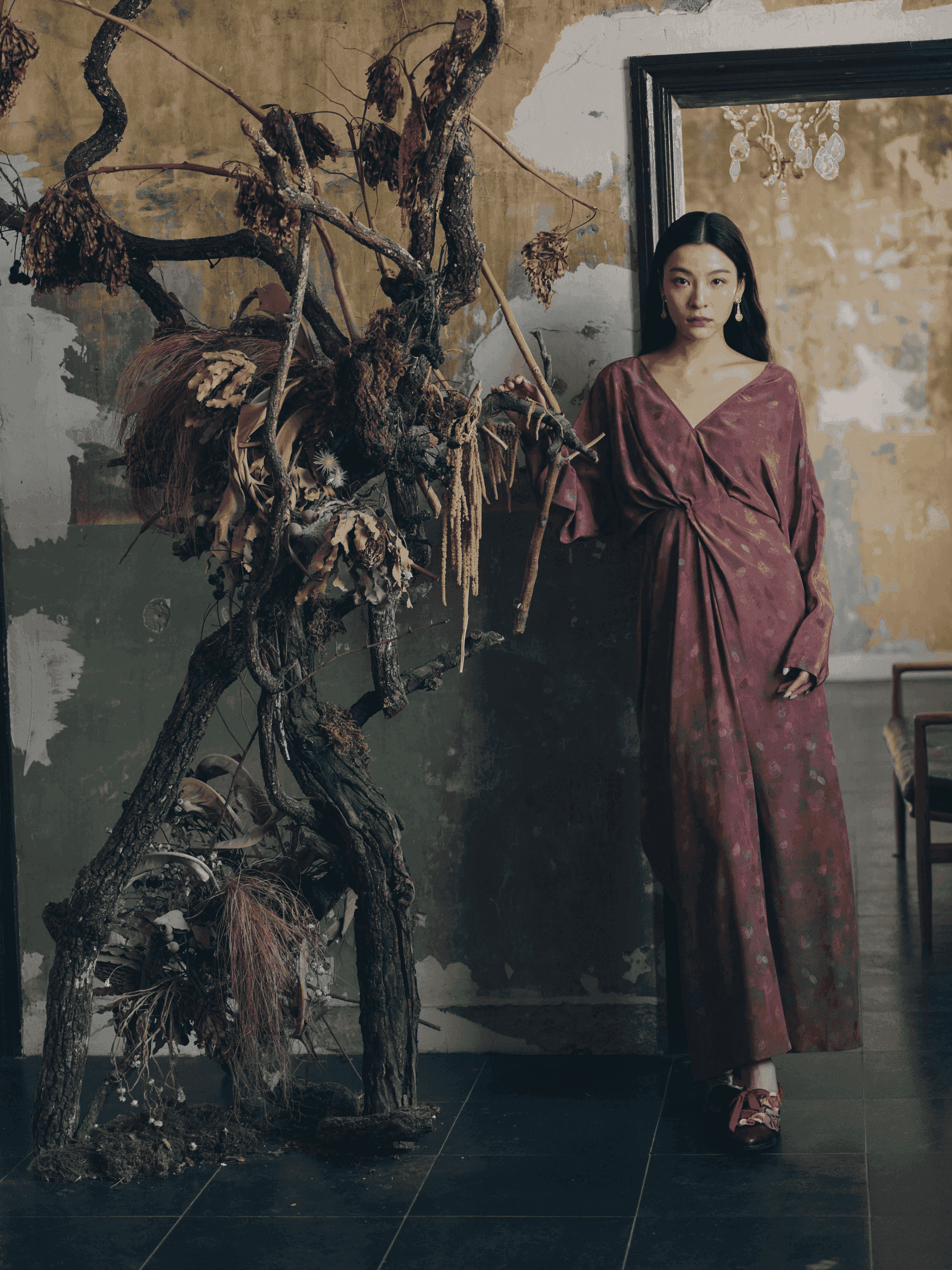
Stripe Fission
Here the stripe is treated as construction. Vertical lines elongate; diagonal interruptions create tension. Using cotton twill, linen, and silk crepe, we engineered stripes that bend with the body and seams that read as graphics. Precision serves movement, not the other way around.
Daytime Fireworks
Fireworks seen in daylight refuse to be ignored. This collection tempers audacity through craft: silk brocade, metallic linen, and sequined mesh are cut into commanding silhouettes. The brilliance is held by structure; without it, the effect would collapse into noise.
What does a tempered garment ask of its wearer?
A tempered garment is not meant to be consumed and discarded. It is meant to age. Silk will soften at the stress points; linen will crease and recover; cotton will take on the shape of repeated movement. These changes are not signs of wear but evidence of a relationship.
We ask the wearer to treat the garment as a collaborator. For silk and cashmere, hand-washing or dry cleaning preserves the fiber’s integrity; wool and mohair knits should be laid flat to dry; the care label carries the final word. The less aggressively a garment is cleaned, the longer it retains its temper—its particular balance of give and hold.
“Beauty outward. Reflection inward. A world unto oneself.”
In the end, tempering is not something you see at first glance. It is in the way a pleat falls, the exact width of a seam allowance, the hand of a fabric that has been chosen to improve with time. The worktable begins the garment; the wearer completes it.
Dili Design Team — Architectural design and fabric craft.


