


Design Philosophy
Eastern Aesthetics in Modern Womenswear: A Design Team's Perspective
“Eastern aesthetics” is often reduced to a dragon, a fan, or a silk print. In our atelier, it is a grammar of making: restraint as a cut that refuses excess, asymmetry as a deliberate imbalance that lets the body move, and negative space as the air between cloth and skin.
What do we mean by Eastern aesthetics in garment construction?
For Dili, the name itself — 砥砺, tempering stone — sets the terms. We are less interested in quoting tradition than in applying its disciplines: the patience of refinement, the courage of emptiness, the belief that a line gains power from what it leaves out.
Four principles guide our pattern-making:
- Restraint — not minimalism as a trend, but the removal of anything that distracts from the silhouette.
- Controlled asymmetry — a measured shift that creates motion without collapsing into accident.
- Negative space — the deliberate void that lets the form breathe.
- Dialogue between natural and constructed — soft drape held by precise seam, fluid grain arrested by architectural line.
These are not mood-board ideas. They show up in the grain, the seam allowance, and the silhouette. A principle becomes a pattern piece; a concept becomes a hemline.
How does negative space become a physical cut?
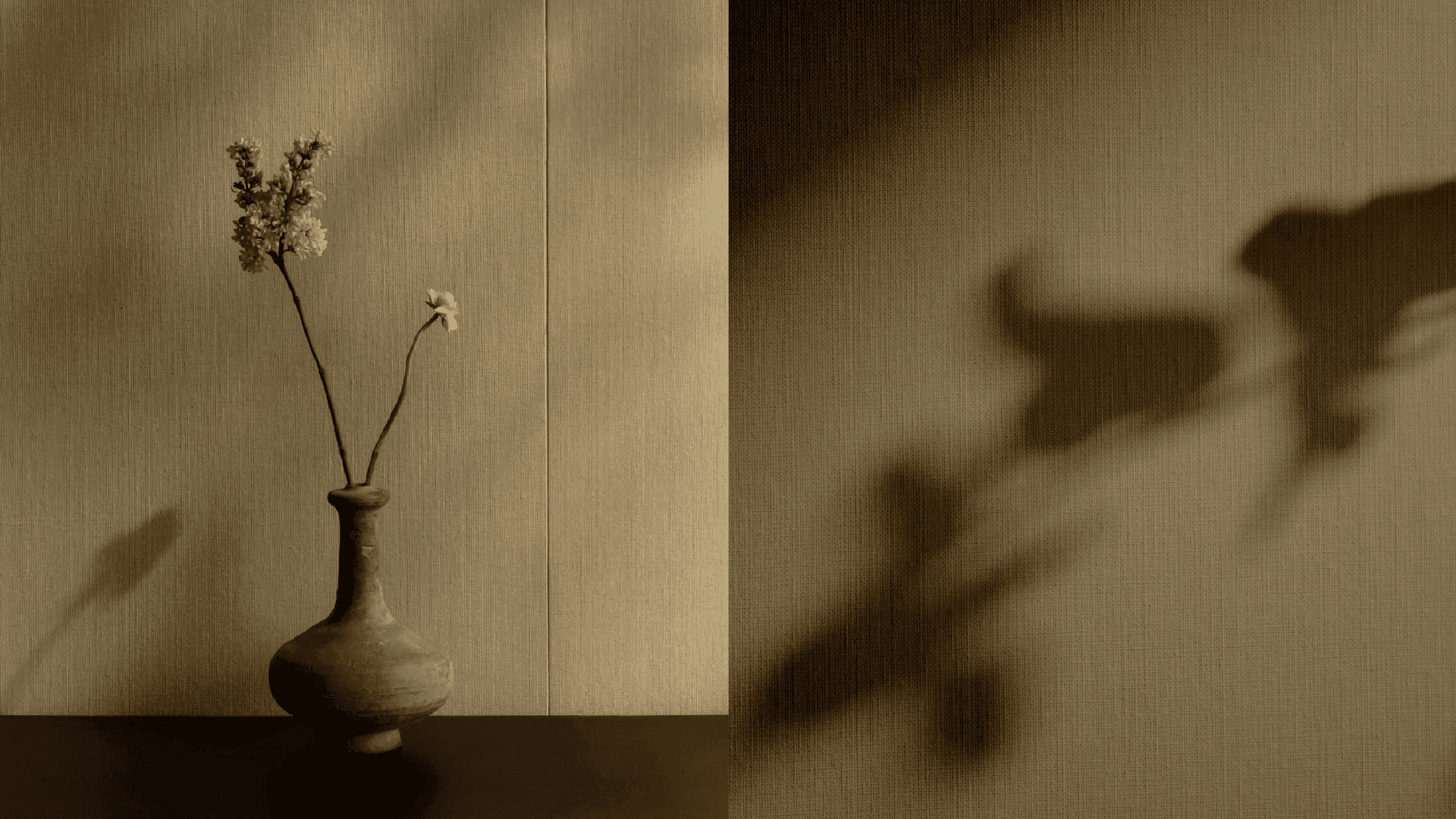
In ink painting, the blank ground is as considered as the brushstroke. We treat the body the same way. Negative space in a garment is not emptiness; it is breath — eased ease around the torso, a dropped shoulder that lengthens the neck, a column skirt with no waist suppression, a sleeve extended past the wrist so the hand appears within the garment’s interval.
In our Nine Orchids collection, we cut mulberry silk dresses with asymmetric hemlines so the line would not close too neatly. The orchid in literati painting grows toward light; it is never perfectly centered. We mirrored that behavior in the hem — one side releasing, one side longer, the body visible in the gap. The result is not a costume reference to a flower but a structural echo of its temperament: strength that unfolds in solitude.
Asymmetry is always measured. A one-shoulder drape, an off-center closure, a side-seam panel that steps — each is set to a specific degree. Too much becomes theater; too little becomes a mistake. The discipline is in the calibration.
Why is structural philosophy different from surface motif?
A surface motif can be applied to any shape. A structural philosophy changes the shape itself. This is the difference between a dress printed with bamboo and a dress whose own lines describe the patience of bamboo.
We do work with print and brocade — our Daytime Fireworks collection carries metallic jacquard and shattered-sequin surfaces — but the surface must emerge from the architecture. In Stripe Fission, stripes are engineered to bend with the body; seams become graphics. The stripe is not decoration pasted over a form — it is the record of the cut. When an orchid print appears as a jacket lining in Nine Orchids, it is a private reference, not a public claim.
“The garment should teach you something about its own making. If the only lesson is ‘this looks Eastern,’ we have failed.”
Surface motif is quick. Structural philosophy is slow. It requires deciding where the fabric yields and where it refuses.
How did Daytime Fireworks put these principles into occasion wear?
Occasion wear often constricts: tight waist, heavy skirt, visible armor. For Daytime Fireworks, we asked how the audacity of fireworks visible in daylight could translate into form rather than ornament.
The collection uses silk brocade, metallic linen, and sequined mesh. Key pieces — metallic jacquard blazers, iridescent pleated skirts, and sculptural evening pieces — hold their shape through construction, not padding. We cut wide sleeves and extended shoulders to create negative space around the arms. Pleats are set so they catch light as the wearer moves, like a firework held in the moment before it fades.
The fabric choice itself carries the idea. Metallic linen has the weight and memory to drape cleanly; sequined mesh catches and releases light. These materials do not shout — they reflect. The woman wears the occasion; the occasion does not wear her.
How does a global wardrobe absorb these traditions?
A garment becomes global when it can travel: to an office, a gallery, a dinner, a different city. We avoid literal historical references — no standing collars added as an afterthought, no tassels that signal “East.” Instead, we translate the discipline.
A long fluid line reads as elegance anywhere. A single dramatic proportion — one strong shoulder, one released hem — reads as confidence, not costume. Natural fibers help: silk, cotton, linen, cashmere, wool age with the wearer and soften into a personal patina. A garment that begins as a design statement becomes, over time, a quiet part of someone’s daily architecture.
The goal is not to dress a character from history. It is to give the modern woman a vocabulary of form that happens to be rooted in Eastern disciplines of making.
Caring for garments that breathe
Because these garments rely on natural fiber and considered construction, they respond to care:
- Hang silk and brocade on wide, padded hangers so the shoulder line keeps its set.
- Steam rather than iron where possible; let gravity ease creases out of pleats.
- Store sequined pieces flat or with breathing room between garments.
- Allow linen its creases. They are part of its memory, not a flaw.
A garment treated with patience will return patience: softer drape, cleaner line, a longer life.


