

What does silk-cotton feel like? It feels like a conversation between two temperaments. For Collection I: Nine Orchids, we chose this hybrid because the orchid itself is not a single note — it is strength held in a curved line, virtue that needs no audience. The blend gives us silk’s liquid drape and quiet shine, held in check by cotton’s grounded hand and tensile memory. Against the skin, it is cooler than pure silk, less assertive than pure cotton, and more honest than either one alone.
What does silk contribute, and what does cotton hold back?
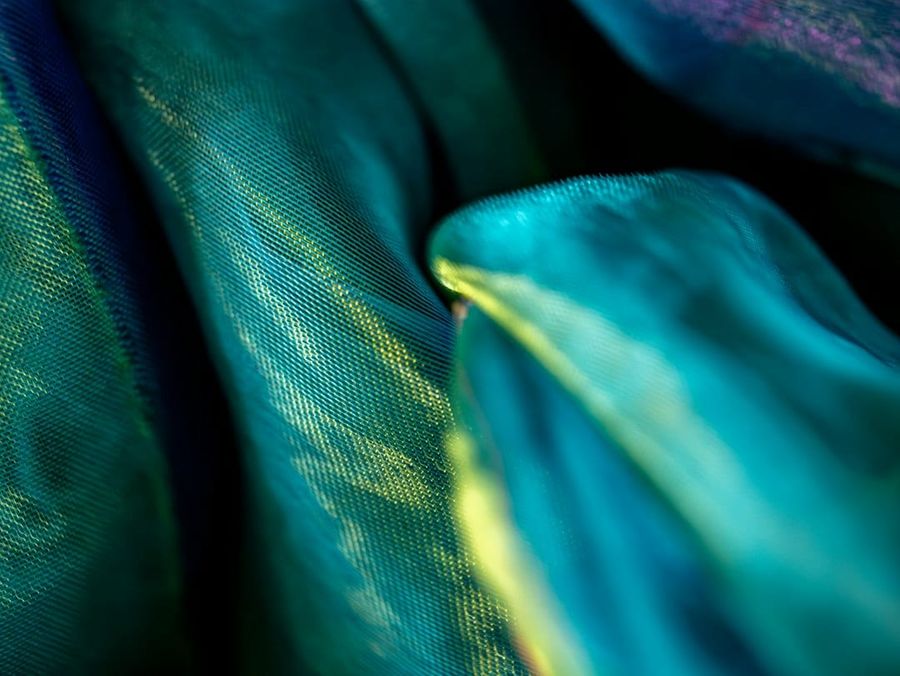
Silk arrives as a continuous filament. Drawn from the cocoon, it is long, smooth, and low in friction, which is why it slips over the body and catches light in a single, soft plane. It absorbs moisture, so it feels cool on first touch. It drapes because the filaments have almost no memory of their own — they follow gravity and fold where the body asks them to fold.
Cotton, by contrast, is a staple fiber. Each strand is short, crimped, and matte. Where silk yields, cotton resists. It gives the cloth tensile strength — the ability to hold a seam, to keep a shoulder line, to recover from being gathered into a pleat. It also gives the surface a dry, grounded hand that keeps the fabric from feeling too precious to live in.
In the blend, the silk filaments travel through a cotton matrix. The result is a cloth that moves like water but remembers its banks. It has enough body to stand away from the body in architectural cuts, yet enough give to follow an asymmetric hemline as the wearer turns.
How does it feel against the skin and move on the body?
Pure silk can feel like a secret — cool, luminous, slightly apart from daily life. Pure cotton can feel like a known room — familiar, breathable, sometimes a little too certain of its shape. Silk-cotton sits between them. On the skin, it has the smoothness of silk without its chill, and the breathability of cotton without its crispness.
On the body, the blend behaves like a living silhouette. It does not cling with static, nor does it balloon away from the form. It follows movement, then settles back through gravity rather than elastic force. In the Nine Orchids dresses, this means the pleats release and fall with each step, while the structured jackets keep their line through an evening.
How does it behave at the worktable?
The way a cloth behaves under the hand tells us whether it belongs in a collection. We cut the Nine Orchids pieces on the bias where we wanted the fabric to stretch and flow — along the diagonal grain, where the weave opens and the cloth gains a natural elasticity. A silk-cotton blend yields on the bias more willingly than pure cotton, yet with more control than pure silk. This is what lets us cut the orchid-curve dresses: the fabric gives just enough to trace the body, then settles.
Under the iron, cotton gives the seam a clean, set memory. Silk keeps the press from looking hard. We finish seams by hand where the construction meets the skin, because the blend takes a rolled edge well — it does not fray as readily as pure silk, and the needle hole is less visible than it would be on 100% silk.
A fabric that cooperates too much becomes costume. A fabric that refuses too much becomes armor. Silk-cotton negotiates.
How does it age?
Washing and wearing soften both fibers, but not at the same pace. Cotton, being a plant staple, relaxes and blooms with each wash. Its surface may develop a gentle nap, a kind of quieted fuzz that makes the cloth feel more like skin over time. Silk, being a protein filament, does not bloom in the same way. It settles, gains a patina, and its luster becomes more inward.
Over years, the two fibers move into each other. The cotton softens the hand; the silk preserves the drape. Color settles differently into each fiber — dye lingers in the cotton with a matte depth, while it sits on the silk with a quiet gleam — so the cloth can appear to gain dimension rather than fade. This is the tempering we look for: a garment that becomes more itself the longer it is worn.
How should you care for silk-cotton?
The blend asks for patience, not ceremony. Cool water and a pH-neutral detergent are enough. Avoid alkaline soaps, which can dull silk and stiffen cotton. Do not wring the fabric; support its weight when wet, as water weakens the fibers and the garment can stretch out of shape.
- Wash by hand in cool water, or dry clean for structured pieces.
- Dry flat in shade; direct sun yellows cotton and weakens silk over time.
- Steam rather than ironing directly. If pressing is necessary, use a low temperature and a clean press cloth.
- Store folded for heavier garments; hanging can distort the shoulders and stretch the bias.
- Let it breathe. Natural fibers need air more than they need plastic.
Silk-cotton is not a compromise. It is a deliberate balance — the tempering of two fibers into one cloth. In the Nine Orchids collection, it carries the same idea the orchid carries: strength that does not insist, beauty that does not perform. The garment will outlast the season if you let it age at its own pace.
Dili Design Team — Architectural design and fabric craft.


