

Atelier Process
How Seam Lines Change Garment Fit: A Pattern-Maker’s Logic
By Dili Design Team
A garment begins as a flat plane. The body is not. The seam is the first place where we negotiate the difference.
In our pattern room, a seam is never just a join. It is a line of control. It decides where tension will travel, where fabric will release, and where the silhouette will hold. Move a seam by two centimeters and the same cloth can fall, cling, or stand away from the body in an entirely different way. This is why seam placement belongs at the very center of pattern-making logic, not at the end as a finishing detail.
Why Does a Flat Piece of Cloth Need a Seam?
Cloth is a two-dimensional material; the body is three-dimensional. Without seams, the fabric can only accommodate curves by stretching, tenting, or folding in ways we cannot govern.
A seam lets us divide the body’s volume into smaller panels, each cut and oriented to manage its own share of stress. Gravity pulls downward. The body pushes outward at the shoulders, the bust, the hips. A well-placed seam redirects those opposing forces along its length instead of letting them tear across the grain. Like a fold in heavy paper that turns a sheet into a volume, a seam gives the cloth a memory of shape.
A seam is not a necessary evil. It is the line along which we decide how the body and the cloth will share space.
How Do We Decide Where a Seam Should Go?
We decide seam placement by reading three things together: grain alignment, panel shape, and movement allowance. Each one changes the way the garment behaves on the body.
Grain alignment
The grain is the stable backbone of a fabric. Lengthwise grain resists stretch; bias yields. When we place a seam, we are also deciding how much of each panel will sit on grain and how much will sit on bias. Shift the side seam forward and the front panel may gain a gentle bias give. Move it back and the front becomes more controlled, more architectural.
Panel shape
The seam line is the edge of the pattern piece. A curved princess seam can shape the bust and waist in one continuous line. A straight side seam gives a cleaner, more columnar silhouette. The same body measurement can be interpreted through different panel geometries, and each geometry reads differently when the wearer moves.
Movement allowance
A seam is also a hinge. Place it under the arm and it must tolerate rotation. Place it across the back shoulders and it must allow the arms to reach forward. A seam that looks correct on the table can feel restrictive once the body moves, so we always leave enough ease for the fabric to slide over itself without distorting the silhouette.
Our drafting process follows a quiet sequence:
- Drape a rough calico to see where tension gathers and where the fabric wants to fall.
- Mark the seam line that releases the fold or carries the stress.
- Check the grain alignment for each new panel after the cut.
- Add seam allowance and walk the seam to confirm the panels match in length.
- Sew a first sample, observe it on a moving body, and adjust.
What Happens When You Move a Seam?
Moving a seam changes the architecture of the garment. In our recent collections, small shifts in seam placement have been the difference between a silhouette that floats and one that asserts itself.
Nine Orchids. In the silk dresses, we moved the waist seam lower into the hip line on some pieces so the pleats above could release from a single point like brushstrokes. On others, we kept the seam higher and added structured shoulders and architectural necklines so the softness below had a clear frame. The seam location determined whether the dress read as continuous flow or as a deliberate contrast between structure and drape.
Rose Petals. Here, bias-cut silk panels meet at seams cut at different angles. The seams act like stems: they hold the waist and torso so the surrounding fabric can suggest petal motion. Structured corsetry lines keep the center quiet, while deconstructed ruffles are allowed to bloom outward. Without the seams anchoring the right places, the movement would collapse into simple volume.
Stripe Fission. This is the collection where seam lines become graphics. In the Stripe Fission collection, vertical stripes elongate the figure, while diagonal interruptions create tension. Shifting a stripe-panel seam by a few centimeters redirects how the eye travels across the body. The seam is no longer hidden; it is part of the drawing.
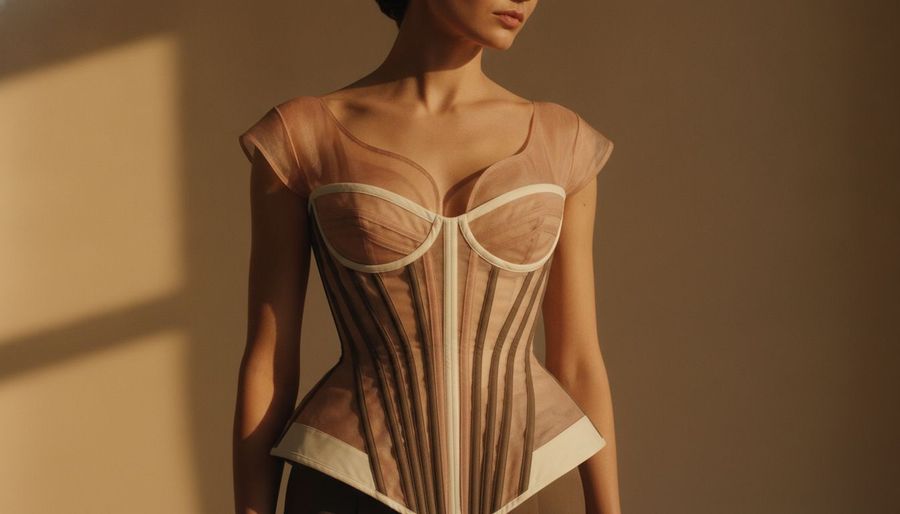
Daytime Fireworks. In the sculptural evening pieces, seam placement determines where the metallic brocade is allowed to explode into volume and where it must stay close to the body. The seams become ribs, giving the garment its posture. Move one seam and the firework changes shape.
How Does Seam Logic Relate to Soft Drapery, Sharp Structure?
Our design language rests on a single tension: soft drapery beside sharp structure. The seam is where the two meet.
Soft drape without structure collapses into mere cloth. Sharp structure without drape becomes armor. A seam holds one panel in place so another can fall. It creates the quiet edge from which movement can begin. In this sense, every seam is an act of tempering: the cloth is pressed, cut, and joined until it carries both give and resolve.
This is the meaning we draw from the name Dili 砥砺—the grinding and sharpening of stone. A seam is not forced onto the fabric; it is refined into it. Each line is deliberate. Each line carries weight.
What Should You Notice When You Try On a Garment?
Reading seam lines on your own body is simpler than it sounds. A few observations will tell you whether the pattern was made with care.
- Look at the fall. Does the fabric hang in clean planes, or does it pull and tent across the bust, hips, or shoulders?
- Follow the seam. Does it follow a natural body landmark, or does it cut awkwardly across a curve?
- Move. Raise your arms, bend, sit. Does the seam stay anchored, or does it shift and strain?
- Notice the weight. Is the heaviest part of the garment supported by the seams, or does the fabric pool and drag?
When these details feel right, you are wearing a pattern that was resolved, not guessed.
A Last Thought on Tempering
A seam line is a decision. It is where the maker accepts that cloth and body are different, and chooses how they will meet. There are no default seams in our studio—only answers to the question of how a garment should hold, yield, and move.
The next time you put on a piece, look for the seam. It will tell you what the maker believed the garment should become.
Dili Design Team — Architectural design and fabric craft.


